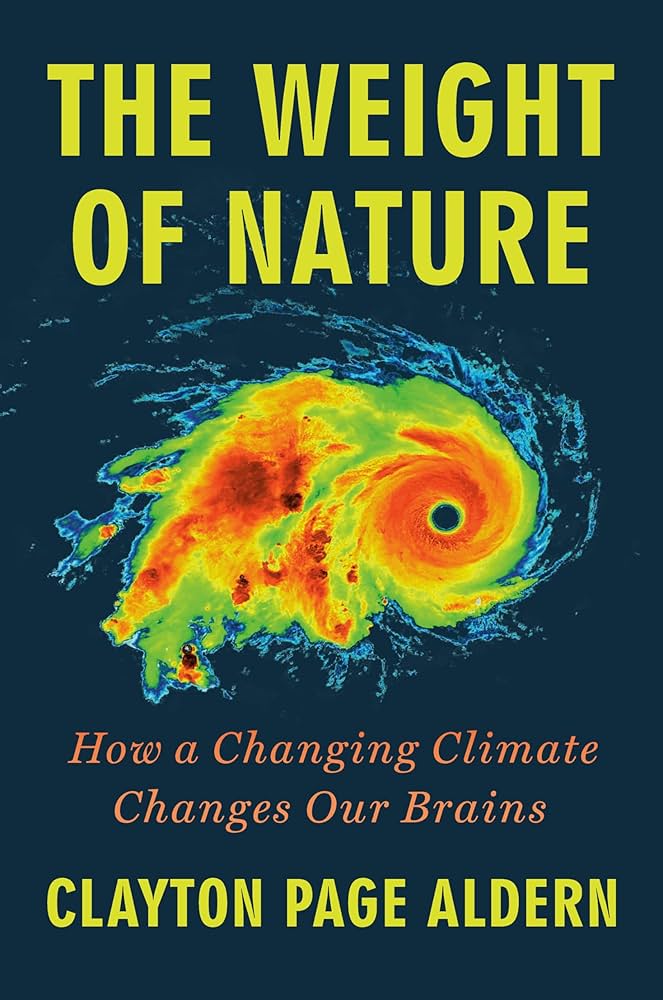
The Weight of Nature
Climate change is changing us from the inside out. Hotter temperatures increase aggression; air pollution and heatwaves impair cognition; wildfires seed PTSD. The Weight of Nature argues that the causal web of global warming constitutes an unreported brain health crisis.
A New York Times Editors’ Choice, Next Big Idea Club selection, Financial Times Best Summer Book, and Sierra Magazine Must-Read.
Praise
“A lyrical and scientifically rigorous account of the emotional and physical toll climate change is taking on the human brain… a unique—and uniquely disturbing—addition to the literature.”
— Kirkus Reviews (starred)
“The rare writer who dares to ask how climate change has already changed us.”
— New York Times Book Review
“Groundbreaking.”
— Newsweek
“Arresting revelations … this is not another book about climate anxiety.”
— Financial Times
“Clayton Page Aldern’s writing is so engaging, his research so novel, and his inquiry into our brains and bodies so timely and revealing that this is a rare climate change book you’ll actually savor.”
— Alan Weisman, author of The World Without Us and Countdown
“It’s hard, at this late date, to write something profound and new about the overarching crisis of our times. But Clayton Aldern has succeeded—this book is a triumph, rigorous in its reporting but also in its thinking and feeling. I learned an awful lot.”
— Bill McKibben, author of The End of Nature
“This important watershed book has powerful immediacy as it explains in a clear, warm voice precisely how climate change is making tiny incremental changes in our brains and bodies. ... Penetrating, intensely personal, and impossible to put down, this is a book you need to read.”
— Annie Proulx, winner of the Pulitzer Prize
“Profound, revelatory, exquisitely written—vital, urgent reading, a lifeline to lead us out of the labyrinth.”
— Isabella Tree, author of Wilding
“Aldern’s is a calm voice in a world of chaos… The book is lifted by the lightness of his prose, his honesty and the maturity of his reflection.”
— The New Statesman
International Editions
UK (Allen Lane / Penguin)

Korea (Chungrim)

Italy (Aboca)

Poland (WUJ)
More translations forthcoming.
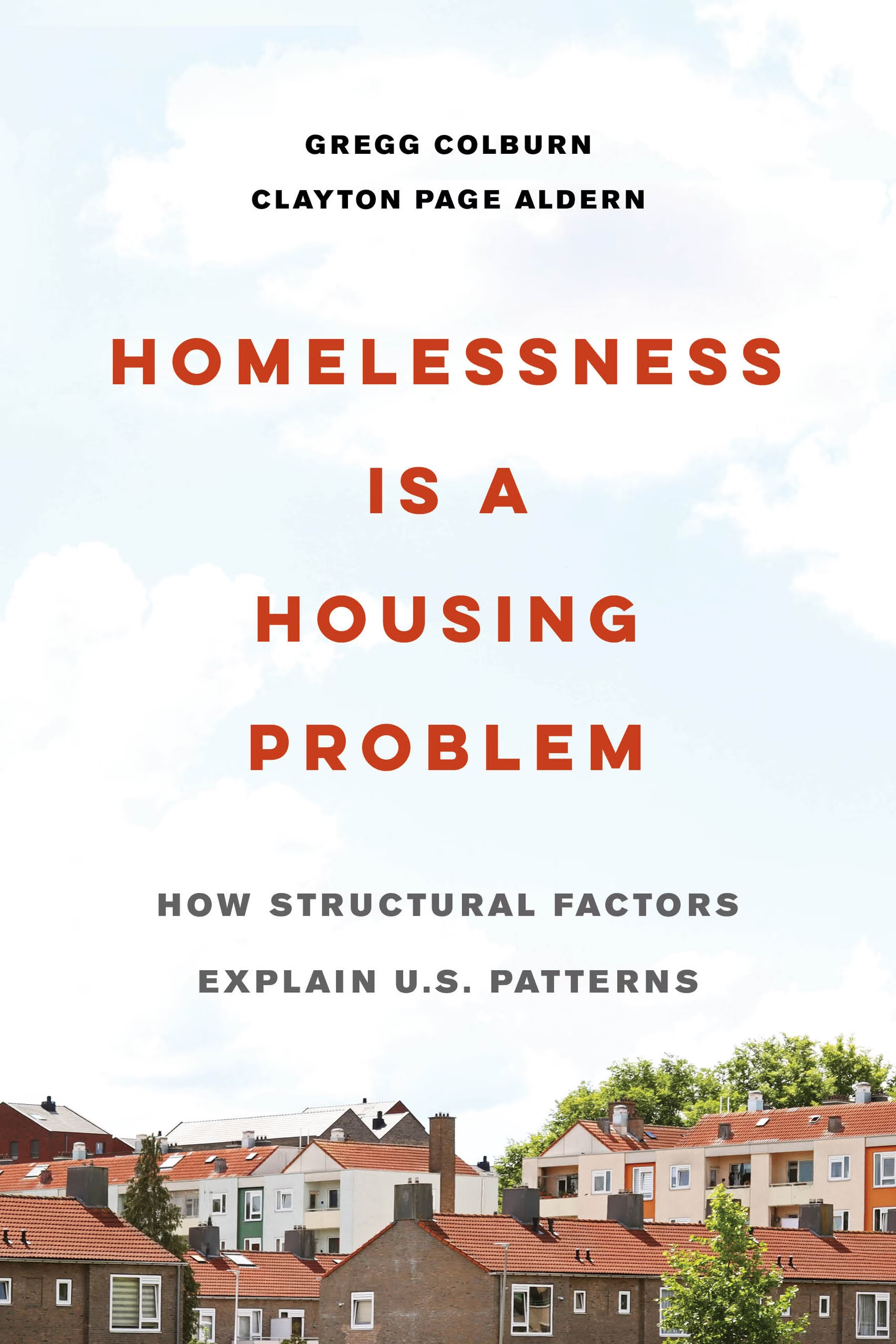
Homelessness Is a Housing Problem
Why do some cities have far higher rates of homelessness than others? Gregg Colburn and I shift the frame from the individual to the metropolitan area. Testing conventional explanations like mental illness, drug use, poverty, and weather, we find that none of them account for the regional variation we observe across the United States. But housing market conditions do: the cost and availability of rental housing explains what individual pathology cannot.
Read a summary. See the book’s website for more.
Praise
“Essential and convincing.”
— San Francisco Examiner
“Should erase any doubt about the powerful role of housing markets in creating homelessness… written with straightforward prose and digestible empirical analyses suitable for academic and lay audiences alike.”
— Journal of the American Planning Association
“There is no shortage of empirical research on homelessness in the academic literature. What is missing is a book like this one, which draws on established research to explain the scope, nature, and underlying causes of homelessness to a non-academic and non-specialist audience.”
— Thomas Byrne, Boston University
“Rents and rental vacancy rates are key drivers of city-to-city variation in rates of homelessness… This excellent book makes a strong case that only the growing gap in affordable housing—not individual failings—can explain the problem.”
— Marybeth Shinn, author of In the Midst of Plenty